
Everyone knows that you have to be financially disciplined to create long-term wealth. But when your brain itself works against you, you need a superhuman effort to stay on track.
LinkedIn is full of posts that tell you to stay invested in stock markets. It’s full of cliches like, “Time in the market beats timing the market”, “A crash is a sale”. And the numbers. Oh, there are so many numbers. And they are all real. ₹10 lakh put into the Nifty Total Returns Index at the start of 1999 would be worth about ₹2.9 crore today, with an annualised 13.3%, according to an analysis by FundsIndia. If you missed the five best trading days of those 27 years and the corpus drops to ₹1.8 crore. Missed ten? It is ₹1.3 crore. Miss 15 and it is ₹97 lakh.
None of this is news to the people reading those posts. The Indian investor who started an SIP knows rupee-cost averaging. They have repeated the argument to friends. The auto-debit did the rest: for months, the money left the account and nothing required a decision.
Then, in some month, they stop the SIP. The standard explanation is that the investor stopped believing the argument. The data on when investors actually stop suggests that the brain evaluating the argument suddenly stopped believing in it.
The Neuroscience Behind This
Initially, this was pictured as a war between a primitive “lizard brain” and a rational brain. That model was called the triune brain, and was discarded by neuroscience decades ago. What replaced it is less flattering.
Self-control is not a behavioural trait. It is an activity, holding a decision steady while the environment pushes on it, and the region that performs it, the prefrontal cortex, is the region stress disables first. Amy Arnsten’s 2009 review, one of the most cited papers in neuroscience, describes how stress signalling “rapidly impair[s] prefrontal cortex cognitive function” and moves control to faster subcortical circuits. We assume that emotion overpowers the rational mind during panic selling. But it doesn’t. Under threat, deliberation is switched off in advance. Don’t blame emotion for your lack of discipline. Blame evolution and the need for survival.
Loss adds a second layer. Losses register roughly twice as intensely as gains of equal size, the finding at the base of Kahneman and Tversky’s work on loss aversion (The Decision Lab). Imaging studies show the amygdala, the brain’s alarm structure, activating specifically when people process financial losses, with its response tracking the size of the loss. When the portfolio falls, the alarm fires in proportion, and the circuits that could hold the original plan are already impaired. The brain that enforced the discipline is the brain that sells.
The India Experiment
India has spent nearly two years watching this operate in public. The Sensex returned nothing over a full twelve-month stretch in 2025. The Nifty went 697 days without a record high, its worst two-year stretch since 2012. The deepest damage was where the newest money sat: small caps fell about a quarter from their January 2025 peak within months.
This is the first real test of a shift that turned Indian households into equity investors. RBI data shows mutual funds rising from 2.1% of household financial savings in FY2021 to 13.1% by FY2025, and direct equity from 1.3% to 2.1%. The NSE counts individual investors growing from about 3 crore in 2019 to over 12 crore in 2025. SIP accounts held ₹15.1 lakh crore by March 2026, with monthly inflows above ₹30,000 crore and equity funds posting 61 consecutive months of net inflows.

The Monthly Numbers
The fund industry publishes one figure that tracks this story in real time: the SIP stoppage ratio, how many SIPs are closed for every 100 opened. Watch what it does in falling months.
January 2025: 109%. The smallcap break that followed: 122.76%, reported as a record. Part of that early-2025 spike traces to a one-time reconciliation in AMFI’s records, so the levels matter less than the shape: the ratio rises in drawdown months and falls when markets steady.
It crossed 100% again in March 2026, when 53.38 lakh SIPs were discontinued against 52.82 lakh opened, and again in April. It eased to 95.46% in May and 81.87% by July.
Some closures are routine: a SIP completing its fixed tenure, or an investor switching funds. Routine closures would be spread evenly through the year. These are not. They concentrate in the months the market falls, which is the signature of market timing deployed through a mechanism built to remove timing from the equation.
The Crash That Did Not Break the Habit
The comparison that makes this an India story is March 2020. In the worst crash of the modern era, SIPs did not stop. Monthly inflows touched an all-time high of ₹8,641 crore that month and kept rising through the year. The panic month did not disconnect the auto-debit. A long flat stretch did what a crash could not: it supplied months of zero return, which is months of uninterrupted reasoning about whether the habit is worth keeping. Fear produces one impulsive decision. Frustration produces a considered one, arrived at over eighteen months, and a considered decision is harder to undo.

What Quitting Costs
The cost of the pattern is measurable. FundsIndia’s analysis also found that seven of the ten best trading days of 1999–2026 fell within two weeks of the ten worst. The investor who closes a SIP in a falling month has, by construction, moved the money out before the rebound.
SEBI’s own data shows how ordinary the early exit is: in FY2022–23, 73% of mutual fund units were redeemed within two years of purchase, and only 3% were held beyond five years. Morningstar’s global Mind the Gap work estimates that bad timing costs investors about 1.2 percentage points a year, roughly 15% of what their funds earn; its India studies find the same lag between what funds earn and what their investors earn.
The Same Behaviour, Different Market
The flat market did not make investors more patient. It moved the demand for movement elsewhere. India is the world’s largest equity derivatives market by volume, and activity inside it is concentrated: 59% of index-options turnover happens on expiry day, 75% within a day of it.
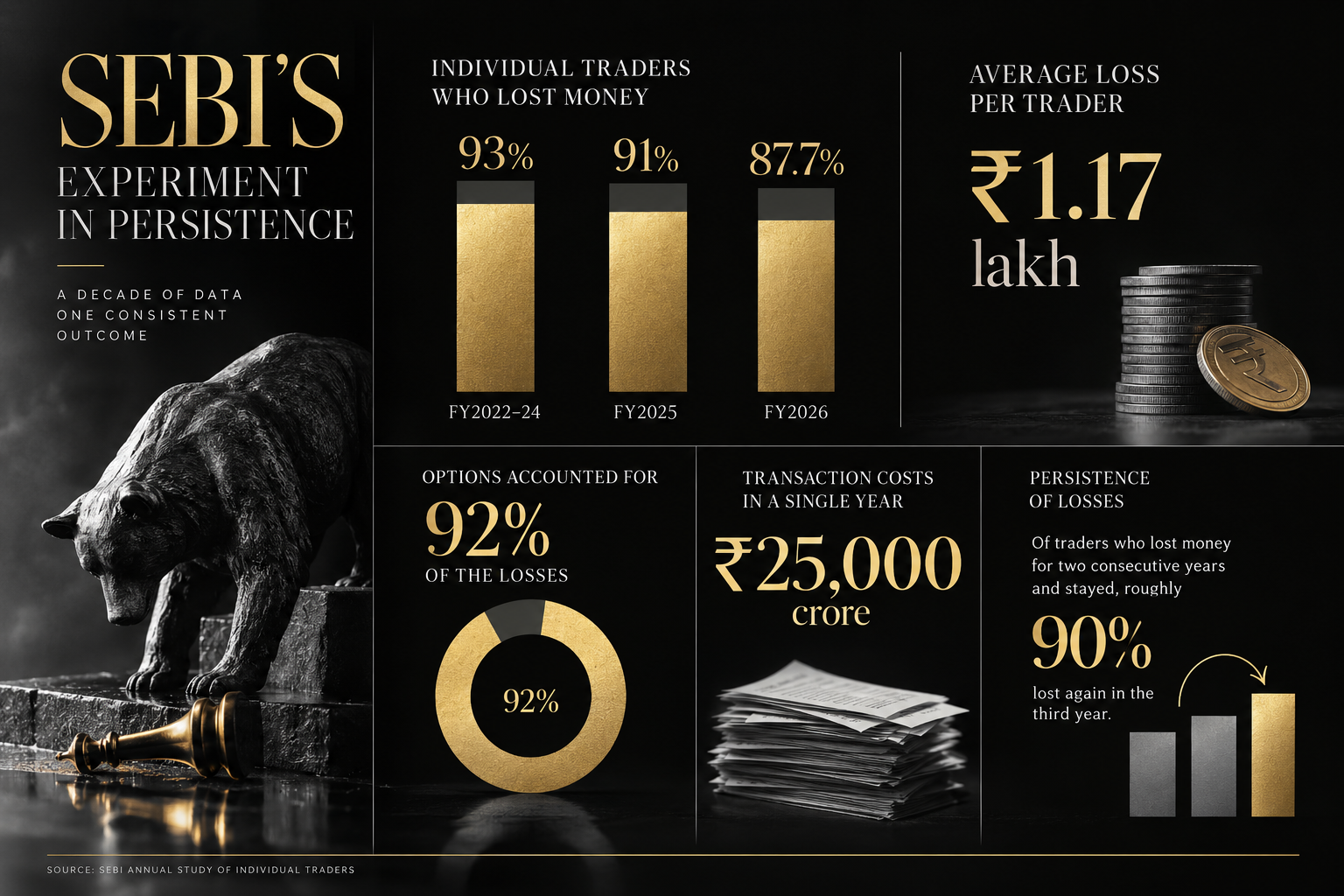
SEBI’s annual study of individual traders is the closest thing finance has to a controlled long-run experiment in persistence. 93% of individual traders lost money in FY2022–24, 91% in FY2025, and 87.7% in FY2026, with an average loss of ₹1.17 lakh. Options produced 92% of the losses, and transaction costs consumed ₹25,000 crore in a single year. Of the traders who lost money for two consecutive years and stayed, roughly 90% lost again in the third year.
SEBI ran the country’s most sustained investor-education campaign through all of this. It changed no outcomes. Participation fell only after SEBI changed the structure: higher margins, fewer weekly expiries, upfront premiums. Warnings did not work. Friction did.
Lawyers Have Met These Investors
Lawyers meet both halves of this behaviour in their own practice. The litigant who keeps funding a claim after being shown, in writing, that the case is weak and the costs exceed any realistic recovery is the derivatives trader: a mix of hope, sunk cost, and the ordinary inability to register a loss as real until it is stamped on paper.
The client who wants to settle at the moment the case looks worst, when anxiety is highest, is the SIP-stopper of March.
The legal system is built on the recognition that you cannot reason people out of these states. Limitation periods, court fees, notices, hearings, the requirement of counsel: none of these exist to add ceremony. They exist because the system assumes that a party in distress cannot be trusted with her own judgement, and procedural friction is the correction. It is structurally impossible to make a bad legal decision at 11 pm.
The investment system removed that friction. Two taps in an app, no fee, no signature, no one to answer to, money credited instantly. Finance took the discipline that fails first under stress and left it as the only line of defence.
Design Beats Argument
The investment policy is the counterpart of the procedural rule. Write the plan and the horizon down. Set rules for yourself like a SIP closure has to wait 30 days before you execute it. These are the same devices lawyers impose on clients, applied to the person who needs them most. The next post telling you to stay invested will be correct, and it will change nothing.The arithmetic was never the problem.
The five best days of these 27 years arrived within the fortnight of the ten worst