
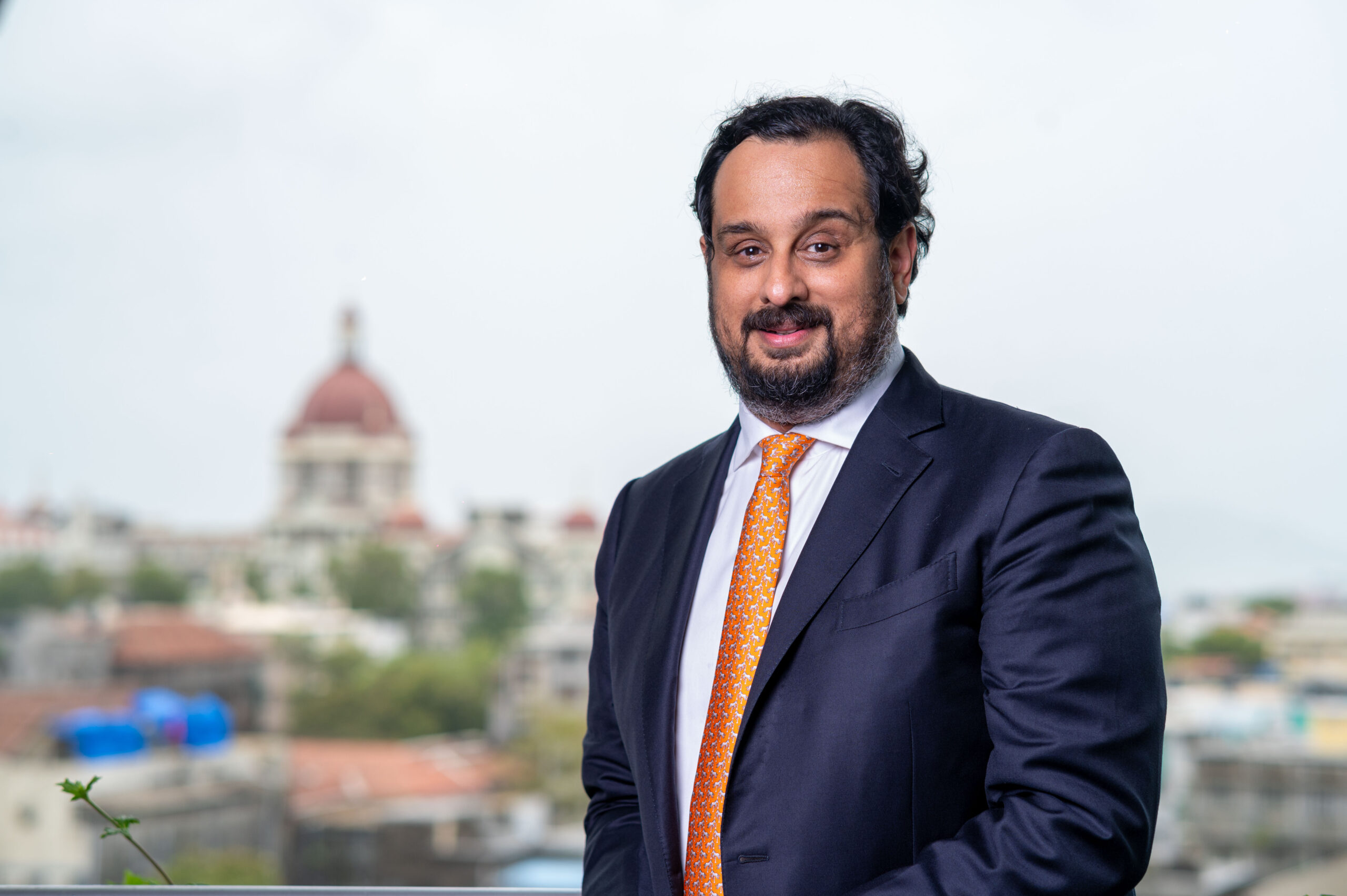
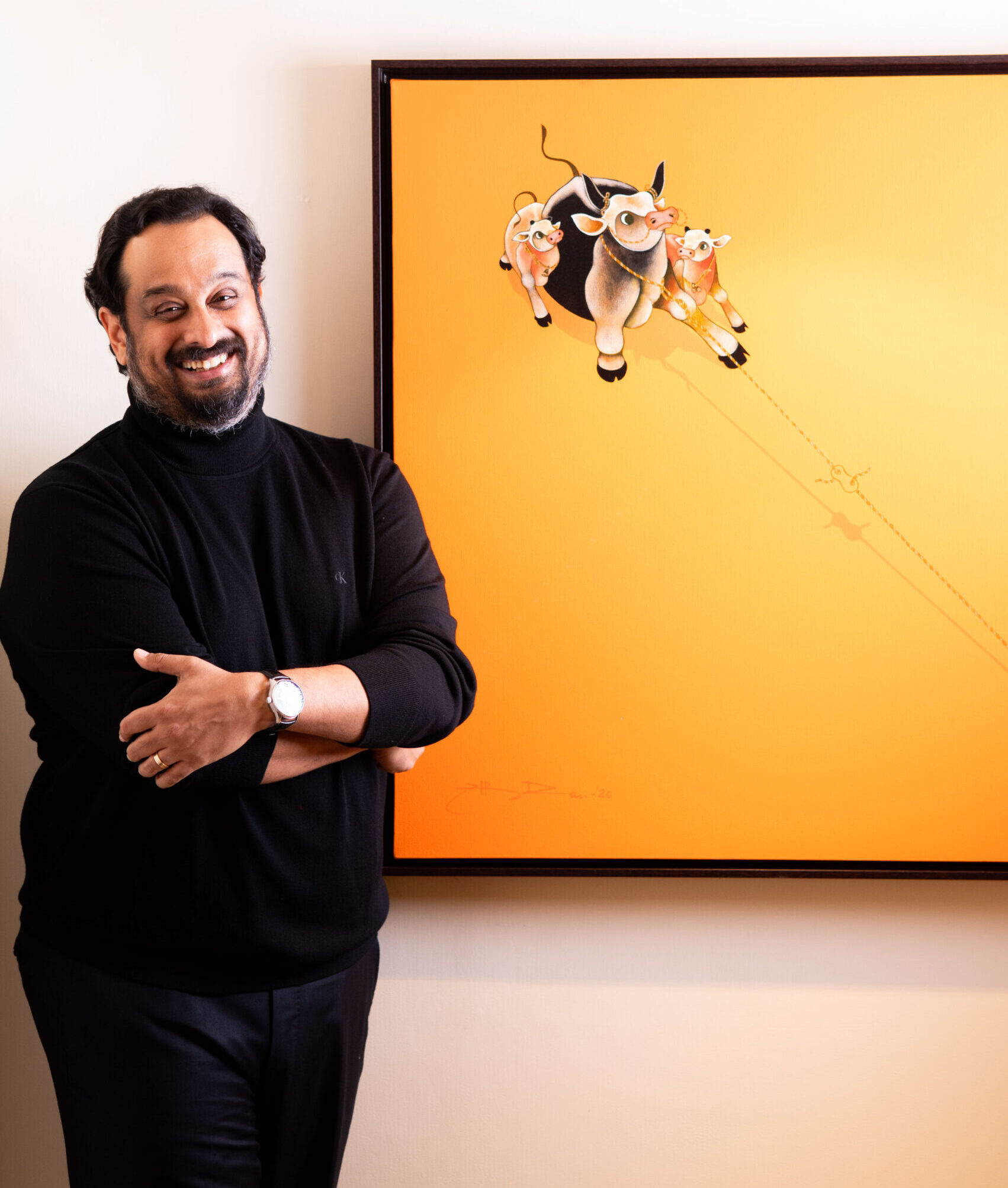
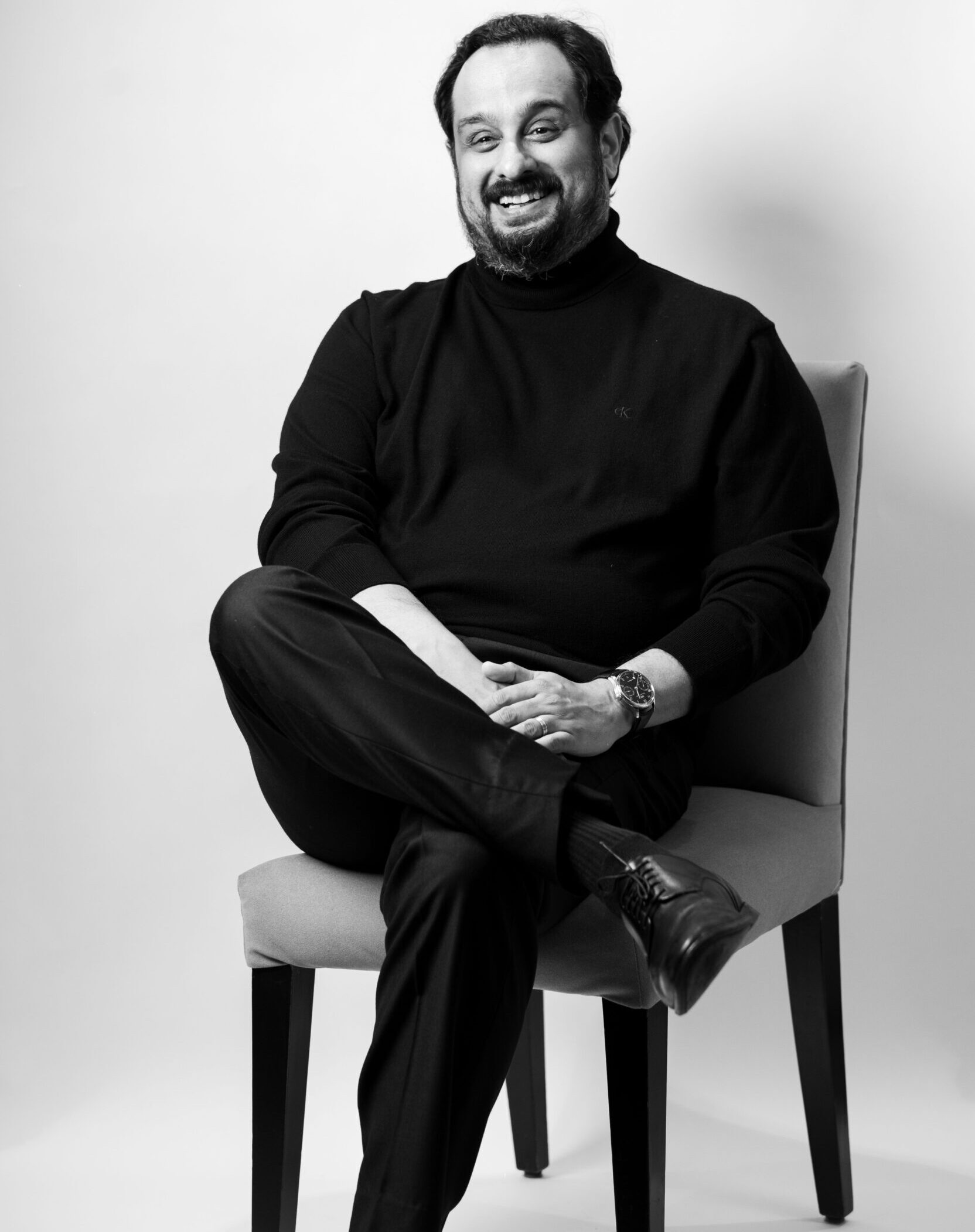
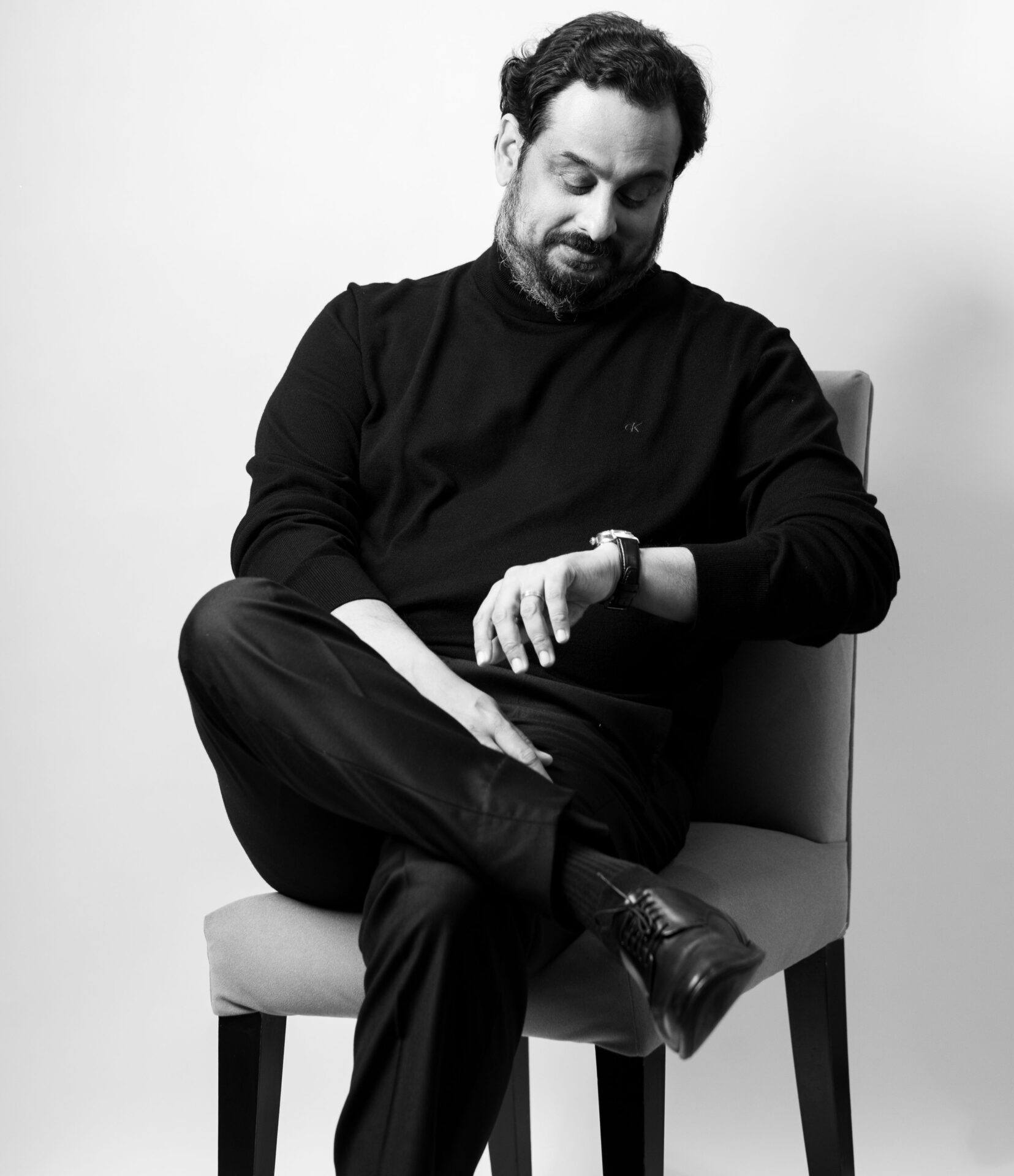
We are at blue-chip M&A lawyer Ashwath Rau’s airy, art-punctuated living room at a private luxury residential complex in South Mumbai. The walls offset the space’s neutral upholstery with high-voltage canvases by Paresh Maity, D Prabha, and HR Das.
The star feature – beyond our dapper host – is a semi-circular balcony overlooking iconic colonial architecture and flourishing palm groves. As a bizarre profusion of skyscrapers and flyovers snake around new-moneyed towers, this feels like ‘Bombay’ over Mumbai…an ‘Exhibit A’ of a more graceful, less greedy skyline.
One sees the proverbial ‘Complete Man’ in Ashwath early on, as he promptly takes his daughter’s calls from school, soothes her apprehensions, and speaks in Kannada to the chauffeur to fetch her as she is down with a viral.
“I try to prioritize my two daughters,” says the lawyer, referring to Antara and Ahana. Rau had his two girls from his first marriage, and is now married to an AZB partner, Jasmin Karkhanis Rau.
“Life is a balancing act; one is always juggling, multitasking,” shares Ashwath, who in legal circles is appreciated by his clients and colleagues for precisely this ability. “One has to sometimes jump between 20 things in a day, and yet, when executing one job, give that one job your 100 percent focus.” The ability to concentrate developed as a national-level rifle shooter amongst other sports he pursued competitively that also taught him to be a team player. He credits his success entirely to his team, particularly his partners and unstinting support from his loved ones, primarily his wife, daughters and mother.
FOR THE LOVE OF LAW AND NATURE!
Formative decisions, early in life, tend to be serendipitous. Rau’s love affair with the Law was, fascinatingly, aligned to his love for nature. “My eldest cousin sister, Suparna, lives in Bangalore…she and I are very close. We both have the gift of the gab. She actually applied for me to go to NLSIU without my knowledge and told me that she had, one week before the entrance exam! I wasn’t at all contemplating doing law, but she actually said, ‘Now you pack your bags and come for a fun weekend with your cousins. Whether you want to do law or not is irrelevant.’ So I guess it was fated.”
Leaving Chennai for Bangalore and then heading 16 km out to see the gorgeous National Law School India University, 30 years ago, brought his young spirit instant clarity. Back in that era, it was a world of fragrant eucalyptus trees, air-conditioned weather, undulating hills meeting clouds… and even highly visible snakes!”
The campus is in a place called Nagarbhavi, which in Kannada literally means “well of snakes,” we are told. Clearly, the Universe was offering Ashwath a healthy juxtaposition of snakes and ladders, given education is a major ladder!
“I was thinking…hmm… five years studying in a hill station… perfect!” he smiles, as the family was used to visiting Ooty and Kodai for holidays. Then came the aptitude test. “I was like, ‘My God, now I have to do my best’! I scraped through and got in. I love to joke that the campus was a bigger reason to do law than law itself!”
Few may know that back then, the little-known NLSIU was actually an experiment of the Bar Council. Today, Rau credits it with laying a rich foundation for his dynamic career, and reminds us that it has “actually been the top law school in the country for over 30 years.”
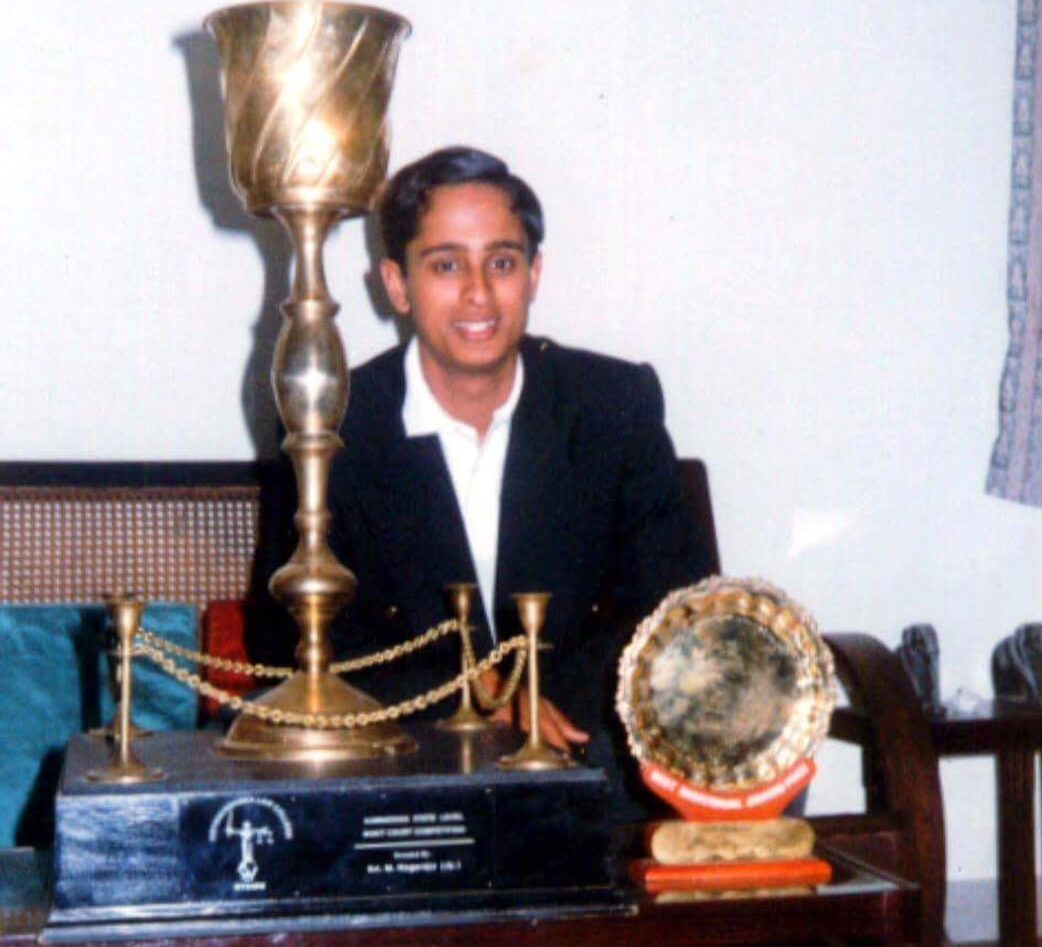
Young Ashwath with the BCI moot court competition winner trophy
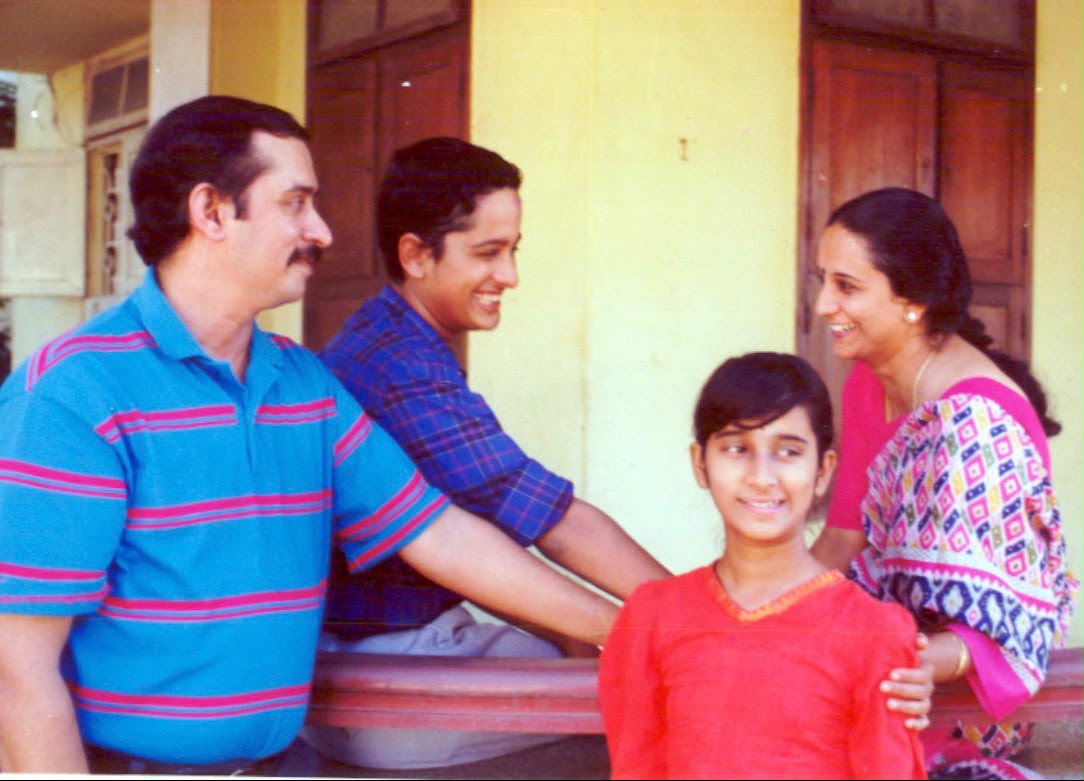
A candid memorable family moment with his dad, mom and sister
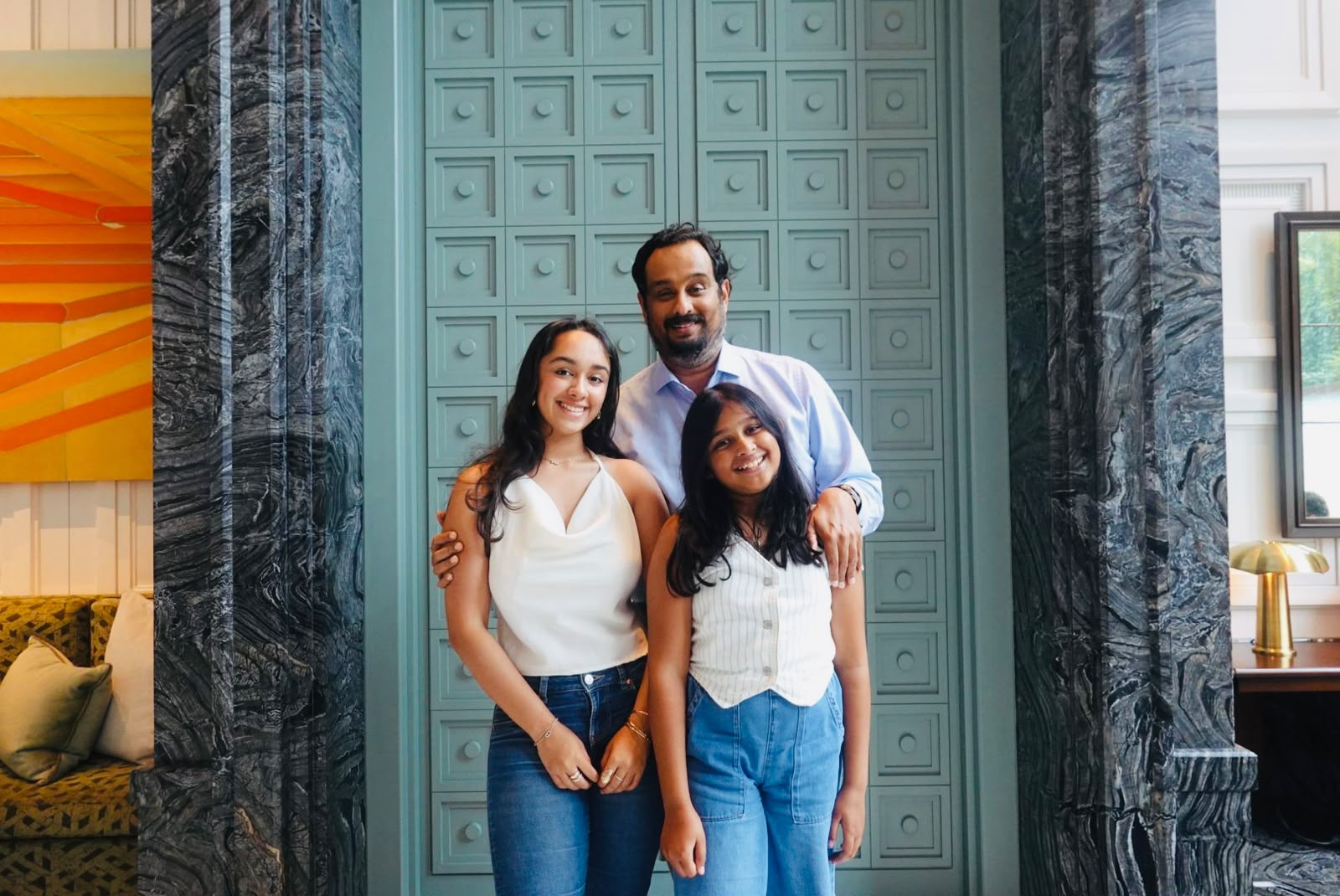
Ashwath with his girls Antara & Ahana
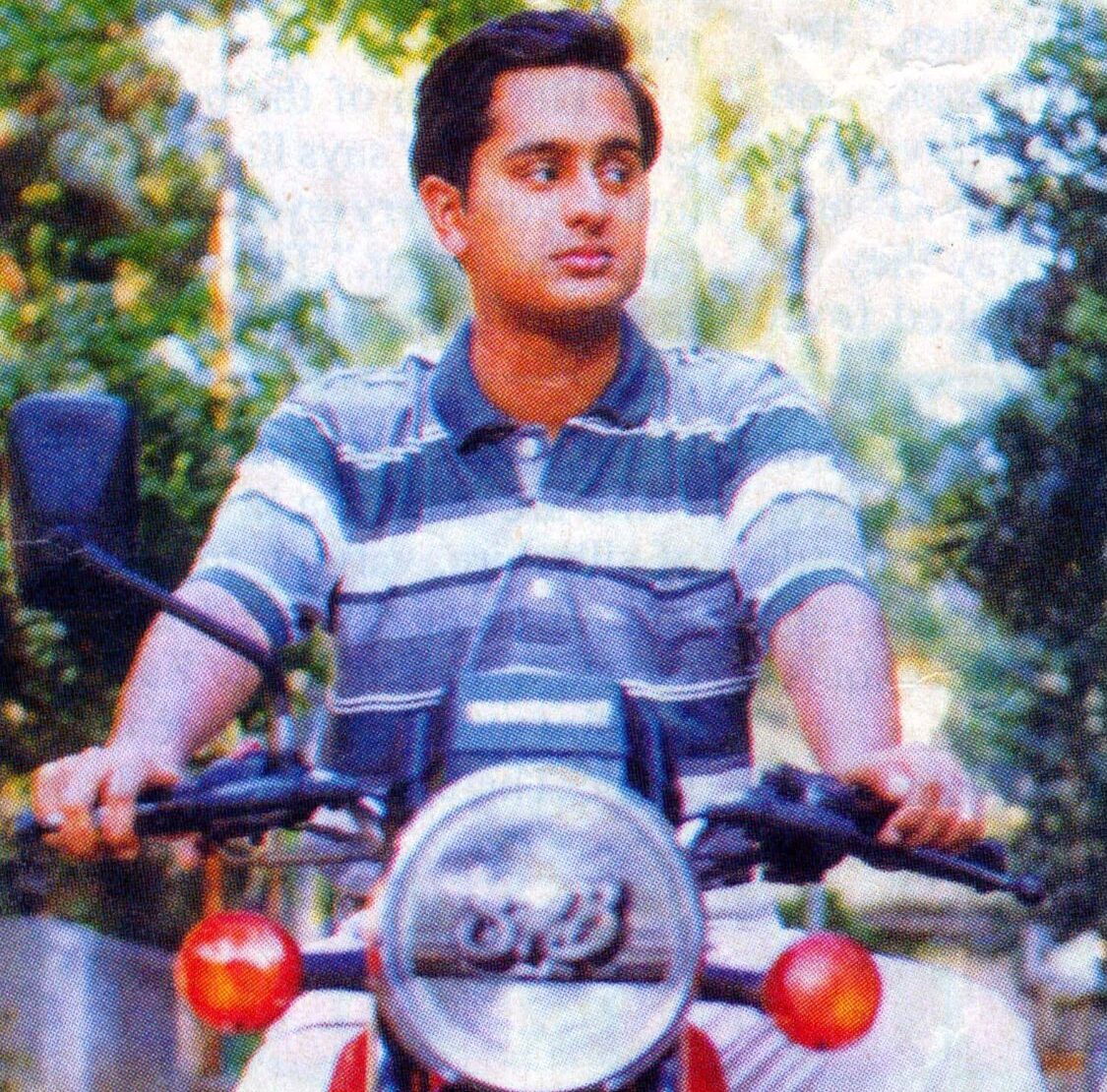
Ashwath during his college days
“ “I'm literally the black sheep of the family – in the black coat! In my family and friends’ circles, you had three choices – be a doctor, engineer, or be stupid!” ”
THE REAL JUNGLE OF CORPORATE LAW
Graduating in 1999, he had a choice between becoming a litigator and being a corporate lawyer.
“I realized litigation is much harder to succeed in, as an outsider,” he confesses. “I remember when I graduated, law firms had already started making corporate law a realistic career option.”
In today’s globalized ecosystem, ‘realistic’ is an understatement, of course. Top corporate lawyers literally live by the ‘time is money’ motto.
So Ashwath was recruited as a fresh graduate by Cyril Shroff of Amarchand Mangaldas. That blossomed into a 16-year-long journey, full of solid exposure and learning, but in time, the firm went into a split.
“I continued for a year after the split – staying with the Cyril Amarchand part of it. I didn’t see a long-term future there, despite having the high regard for Cyril Shroff and many longstanding friends in the firm.”
Ashwath moved to AZB. “Zia and I had interacted across the table on several matters, and she is the lawyer I admire most.”
A US-INFLUENCED CORPORATE CULTURE
Rau found AZB to be a refreshing shift. And yet, he was hardly ‘new’.
He had a history with Zia as an intern. “I did my internship with her in my fourth year of college and kept calling her ‘Ma’am’!” he smiles.
After having told him not to call her “Ma’am” twice, on the third occasion, she yelled – in the middle of the office – that the term has different implications, and he needed to stop using it with immediate effect!
Having studied at Cambridge and Harvard, and then worked in the US for five years, her approach was shorn of formality and protocol. It is very American that way -‘real’ and ‘fuss-free’.”
In industry circles, however, Ashwath’s migration to AZB & Partners was no ordinary ‘shifting’ of jobs – it was a movement! “A team of about 30 lawyers moved to AZB after I did. So it was less about a lawyer moving; it was more like a small firm joining (at that time) a larger firm!”
Now, all of a decade old at AZB, Ashwath says it has been a “great journey”.
“AZB has allowed me, as well as many others, to leverage a world-class platform and also help grow it. I work closely with Zia to help build our corporate practice. There is a lot of travel and exposure to the best in the international corporate community.”
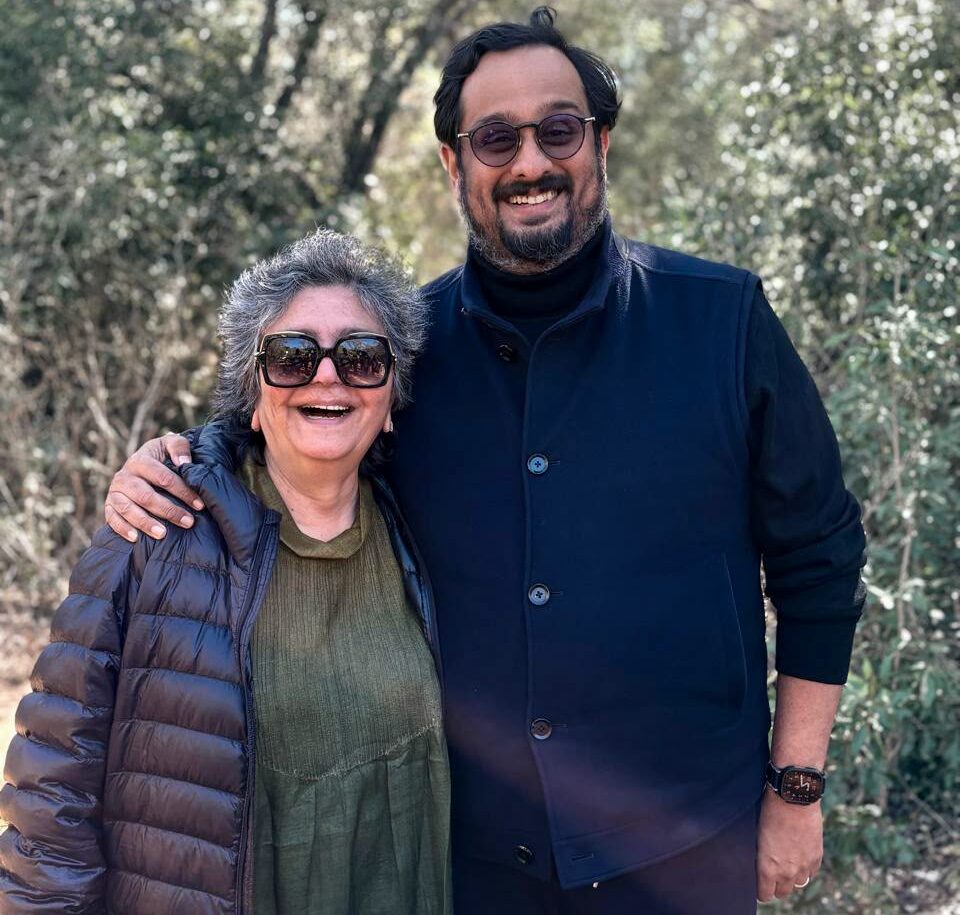
“Zia Mody is a true force of nature. She set up AZB, the firm, on her own, and has stayed on top of her game for over 40 years. It's been a truly dramatic success story”
BUILDING CROSS-CULTURAL BRIDGES, SHAPING THE INDIAN ECONOMY
Given today’s global M&A landscape, building relationships across different economies, legal and emotional structures, is where the game really is. One can see that ‘sharp’ EQ at work when Ashwath makes light of so many aspects of his journey.
“Zia and I are often representing AZB at International conferences, rubbing shoulders with the top lawyers from all over the world. Then, there are also smaller gatherings of the M&A lawyers. Hence, ‘understanding cultural differences’, ‘being mindful of potential landmines in communication styles’ and ‘watching the best in action’ has, in fact, been a rich area of learning,” shares Ashwath.
‘EQ’ WITH ‘IQ’: A KEY INGREDIENT IN THE MIX
Ashwath and Zia often meet clients in multiple markets, like New York, London, Hong Kong and Singapore. “A significant part of our corporate practice is cross-border. We have to understand not just the legal system of a foreign investor or buyer, but their culture and approach. If we want to build trust-based relationships, at a senior level, it’s more about situational reading and people management rather than merely expounding on the law”.
One asks Ashwath to illustrate how cultural differences come into play, by example.
“The French are frank. Sometimes brutally so. The Germans are more so – they can take their final position in a negotiation right off the bat and stick with it till the very end. The Americans, who are the biggest foreign investors in Indian companies, are straight-up capitalists who don’t ‘dress up’ the deal. But we in India are very protocol-oriented. The Japanese are even more so. Both tend to start at the opposite end of the spectrum (in terms of what they want out of the deal) and then work their way to a middle ground. And, like Indians, enjoy the process – remember Amartya Sen’s book, The Argumentative Indian? – the Japanese are not necessarily argumentative, but it is an art and process for them to arrive at the right answer! Like us, they also enjoy the negotiation process.”
Not only do cultural sensitivity, EQ, and the ability to ‘read the room’ pivot things in a negotiator’s favor, but “these factors are as important as your knowledge of the law. Also, let’s be aware that anyone can point out a problem. The important thing would be to find a sensible solution to every problem, rather than a problem against a proposed solution.”
IT'S BLACK, IT’S WHITE…BUT MOSTLY, GREY!
As Ashwath expands on cultural differences, he offers a fresh perspective on the landscape of fuzzy and flexible rulebooks we work with.
“India has a lot of “grey” (room for interpretation) in business and law, and associated risks. It therefore requires a lot of skill to find sensible solutions that don’t subject your clients to unnecessary risk, including reputational risk.”
THE FINE ART OF NEGOTIATION
A fascinating insight Ashwath now shares – nearly three decades into corporate law – is that it is not fundamentally so different from litigation.
“I think the job of an M & A lawyer is as tough as a litigator – while a litigator has to fight an opposing counsel to try and convince a neutral third-party judge, an M & A lawyer has to convince the lawyer he is negotiating with to find sensible middle ground whilst also trying to arrive at the best possible outcome for his or her client.”
It sends a clear message to young aspirants that both a litigator and an M & A lawyer need a good command of words, backed by logical, sound arguments delivered with composure and brevity. “Only the way this skill set evolves is different as you follow your chosen path – be it litigation or transactional practice.”
“ “Americans will talk to the junior-most person if it gets their job done. It's an informal, capitalist approach. They don’t have this VVIP culture, so often seen in our part of the world’ ”
THE WORK-LIFE BALANCE
When not sealing steely deals, Ashwath migrates to a parallel universe… his first love – the sublime ecosystem of Mother Nature. We see portrait after stunning portrait of tigers, lions, leopards, cheetahs, cub clusters, owls, a Kingfisher… and forest sunsets splashed across the open, pure skies, outdoing the finest of Klandinskys and Monets. Imagine the passion and patience Ashwath has, capturing reclusive creatures of the wild!
“As with everything in life, nature rewards patience, effort, knowledge, and experience. A large part of the time in the forests is spent waiting, at spots chosen by an experienced naturalist or guide. We wait, wait… then are rewarded with the arrival of the forest’s royalty… leading to photos and memories to cherish for a lifetime.” In his experience,” the key to success in any part of one’s life is patience, perseverance and perspective”.
To elaborate, he has travelled, camera in tow, to the rich forests of Africa –Kenya (Masai Mara), Tanzania, (Serengeti), Botswana (Okavango Delta) and South Africa. In India, he has visited Bandhavgarh, Kanha, Ranthambore, Pench, Tadoba, Corbett.
“I have made over 55 trips to the above, which include over 10 trips to each of Pench, Kanha, and Bandhavgarh,” he confesses.




“ Being in the wild is often so much more about being fully present and with inner quietude, the antithesis of a data-driven, money-crunching human universe. We have learned much from a few hours around Mr Ashwath Udipi Rau. Even calling him The Complete Man feels too cliched ”