
The Machine Arrived More Quietly Than We Expected.
For years, we had been told to prepare for a violent disruption. The language was always dramatic: professions would disappear, junior lawyers would become redundant, the billable hour would collapse, and legal practice would be remade by code. We watched the predictions accumulate. We tracked the models, the data sets, the legal-tech investments and the increasingly confident demonstrations. We waited for the moment when The Machine would walk into the profession and rearrange it beyond recognition. Then it did.
But it did not break the law. It did something more unsettling. It revealed the parts of legal work that had already become mechanical. The Machine can scan a thousand contracts before a lawyer has finished reading one. It compares clauses, identifies deviations, summarises authorities, drafts first versions, organises disclosure, searches a universe of documents, and offers plausible answers in seconds. None of this is trivial. Much of it is genuinely useful, and some will permanently change the economics of legal service delivery.
Yet the first mistake is to assume that The Machine is doing what the lawyer does. It is not. Or, perhaps more accurately, it is doing some of what lawyers have historically spent time doing. That distinction matters.
We Mistook Process For Practice
The greatest question may not be what AI does to senior lawyers. It may be what it does to the lawyers who are just beginning.
For generations, the legal apprenticeship involved long stretches of repetition. Junior lawyers learned by researching authorities, reviewing documents, comparing drafts, preparing notes, observing negotiations and seeing how more experienced lawyers thought through ambiguity.
Not all of it was glamorous. Much of it was tedious. Some of it was unquestionably inefficient. But embedded within that work was a form of education.
A young lawyer who reviews one hundred agreements eventually develops an instinct for the clause that looks ordinary but is not. A lawyer who researches a proposition deeply enough begins to understand the difference between finding a case and understanding why it was decided that way. A lawyer who sits silently in meetings learns how much of a legal problem is never written down.
If The Machine removes the repetitive work, they may also remove some of the paths through which judgment is formed. This is not an argument for recreating drudgery. It is an argument for redesigning apprenticeship deliberately.
The next generation should spend less time formatting, collating, and searching blindly, and more time learning how an answer is reached. They should observe the first draft generated by The Machine and understand why an experienced lawyer might reject half of it. Training should focus on verifying sources, interrogating assumptions, identifying missing facts, and recognising when a seemingly sophisticated answer is dangerously incomplete.
The future lawyer cannot simply be an operator of tools. They must become the final human in the loop: the person who knows when to rely on The Machine, when to challenge it and when to step away from it altogether.
“ “The next generation should spend less time formatting, collating, and searching blindly, and more time learning how an answer is reached.” ”
I Have Seen This Discomfort Before
I have seen this cycle before, though in a different form.
As part of the founding team at Pangea3, I saw technology change the topography of legal services. The idea that sophisticated legal and intellectual-property work could be delivered from India to clients in the United States, Europe and Australia was, at the time, met with considerable scepticism.
There were questions about quality, confidentiality, culture, communication and control. There were also deeper fears that were rarely stated so plainly: what happens when legal capability is no longer constrained by geography?
Technology made that question impossible to ignore.
It allowed legal intellect to move across borders more easily. It enabled scale. It created new models of delivery. It changed the cost structure of certain kinds of work. And it forced firms and clients alike to reconsider assumptions that had seemed permanent. The profession did not end. But it changed.
Many of those who initially viewed the change as a threat eventually found opportunity within it. New capabilities emerged. New careers emerged. New forms of legal service became possible.
AI is creating a similar moment now, except that the discomfort is universal. It is not a shift affecting one jurisdiction, one segment of the market or one kind of lawyer. It is a challenge to the profession’s own idea of what is valuable.
That is why resistance alone will not help us. The question is not whether The Machine will become part of legal practice. It already has. The question is whether we will use it to remove the noise from our work, so that we can become better at the part that remains.
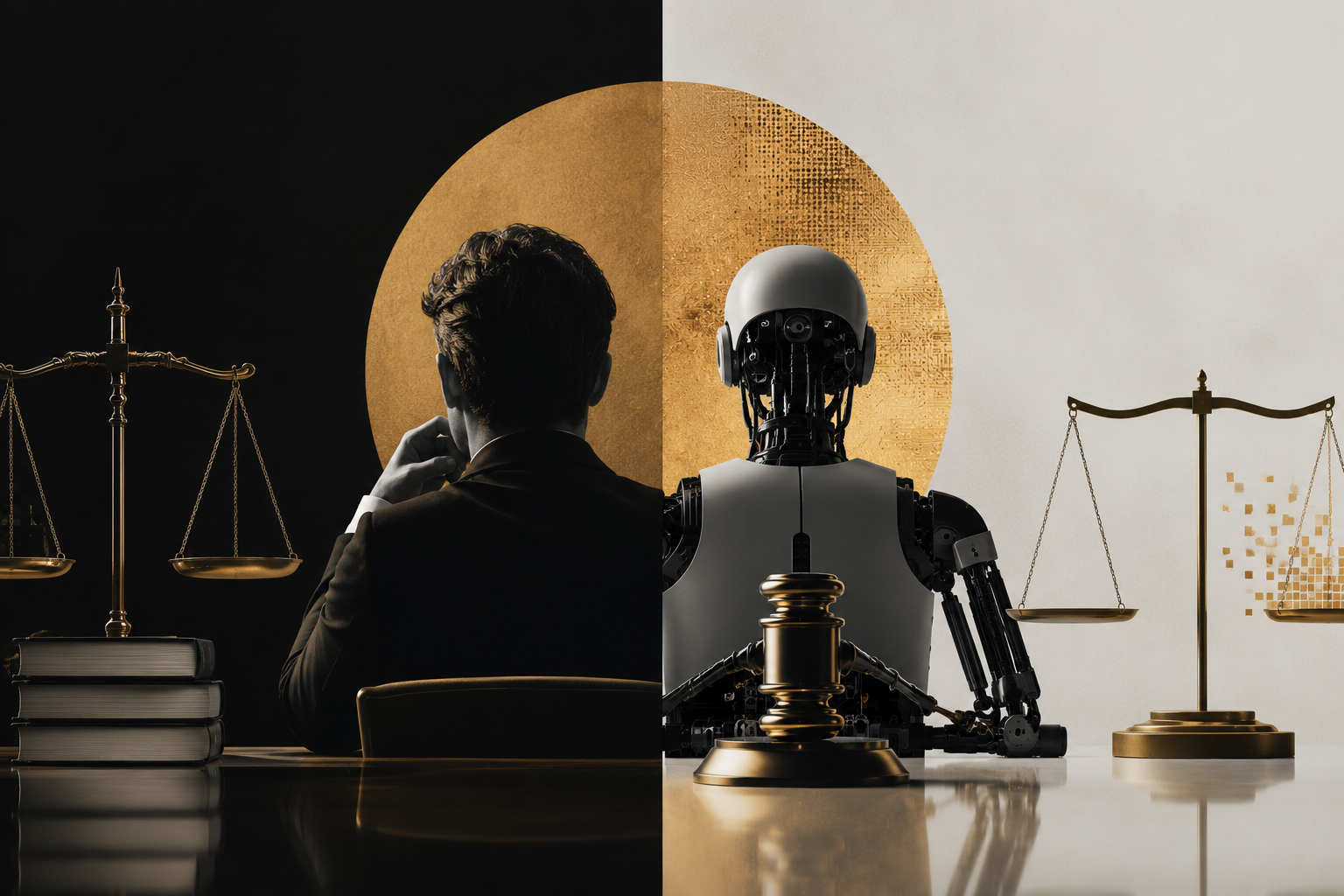
The Irreplaceable Mind is not the mind that refuses The Machine. It is the mind that uses it rigorously, questions it relentlessly and knows when discernment must prevail over convenience.
Judgment Is What Remains
The word most likely to be overused in conversations about AI is judgment.
Yet it is also the right word.
Judgment is not intelligence alone. It is not speed, recall or the ability to identify patterns across a large body of information. It is not even technical legal knowledge, although all of these things matter.
Judgment is the ability to decide when information is incomplete, incentives are unclear, facts are contested and the consequences of error are real.
It is the ability to understand that the legally correct answer may not be the most useful answer for a client. It is the ability to recognise when a technically defensible position carries reputational, cultural or commercial risk that no legal database will adequately capture.
It is also the courage to give advice a client may not want to hear. In difficult moments, clients do not merely need a document. They need someone who can see the whole field: the law, the facts, the personalities, the history, the power dynamics, the timing, the business pressures and the risks that may not yet have acquired a name.
Consider a sensitive workplace investigation. The applicable law and policy may be clear enough. The evidence may be organised. The relevant messages, documents and statements may be extracted and summarised within minutes. AI may help make that process faster and more reliable.
But the difficult questions remain human. What does fairness require in this situation? What does the organisation owe the complainant, the respondent and the wider workforce? How should leadership communicate without prejudging the outcome? What will restore trust? What will cause further harm? What is legally permissible but institutionally unwise?
The Machine cannot carry the moral or professional burden of those decisions. It may inform the process. It may improve the analysis. But it cannot own the outcome. That is where counsel begins.
Trust Has No Shortcut
The legal profession has often assumed that expertise is its principal currency.
It is not. Trust is.
Expertise may get a lawyer into the room. Trust determines whether the client calls when the room is on fire.
Trust is built slowly. It grows through a record of sound decisions, intellectual honesty, and the discipline to say “I do not know” when the facts do not yet permit certainty. It is reinforced by the small moments clients remember: a warning given early, a difficult conversation handled carefully, a risk explained calmly, or a promise kept when no one was watching.
The Machine may be able to predict likely outcomes from past patterns. But it does not understand the cost of being wrong in the way a trusted advisor does.
It does not sit with a founder who may lose the company they spent twenty years building. It does not advise a board facing a crisis that could affect thousands of employees. It does not speak to an individual whose dignity, livelihood or reputation may be at stake. And it does not carry the consequences of its advice.
This is not an argument for romanticising human beings. Lawyers make poor judgments too. We bring our own biases, blind spots, habits and incentives into every room. We are capable of mistaking confidence for wisdom and experience for correctness.
But the answer to imperfect human judgment is not the abdication of judgment. It is better judgment: more informed, more humble, more transparent and more accountable.
The Apprentice Problem
The greatest question may not be what AI does to senior lawyers. It may be what it does to the lawyers who are just beginning.
For generations, the legal apprenticeship involved long stretches of repetition. Junior lawyers learned by researching authorities, reviewing documents, comparing drafts, preparing notes, observing negotiations and seeing how more experienced lawyers thought through ambiguity.
Not all of it was glamorous. Much of it was tedious. Some of it was unquestionably inefficient.
But embedded within that work was a form of education.
A young lawyer who reviews one hundred agreements eventually develops an instinct for the clause that looks ordinary but is not. A lawyer who researches a proposition deeply enough begins to understand the difference between finding a case and understanding why it was decided that way. A lawyer who sits silently in meetings learns how much of a legal problem is never written down.
If The Machine removes the repetitive work, they may also remove some of the paths through which judgment is formed.
This is not an argument for recreating drudgery. It is an argument for redesigning apprenticeship deliberately.
The next generation should spend less time formatting, collating, and searching blindly, and more time learning how an answer is reached. They should observe the first draft generated by The Machine and understand why an experienced lawyer might reject half of it. Training should focus on verifying sources, interrogating assumptions, identifying missing facts, and recognising when a seemingly sophisticated answer is dangerously incomplete.
The future lawyer cannot simply be an operator of tools.
They must become the final human in the loop: the person who knows when to rely on The Machine, when to challenge it and when to step away from it altogether.
The Work Ahead
The Machine is not the enemy of the lawyer. It is a mirror.
It reflects the work that can be standardised, accelerated and delivered at scale. It exposes the processes that had become expensive simply because they were slow. It forces us to distinguish between activity and value. That discomfort may be inevitable. But discomfort has often been the beginning of growth.
The legal profession now has an opportunity to move away from pricing time as though all time carries equal value. It can build systems that make routine legal work more accessible and efficient, freeing lawyers to focus on tasks that demand their full expertise and judgment.
And it can return the profession to its essential purpose: the exercise of trusted, accountable judgment. The Machine can produce a contract.
It can find the precedent, generate the clause, compare the risk positions and propose the first answer. But it cannot decide what matters most when the facts are uncertain and the consequences are human.
It cannot take responsibility for the advice. It cannot sit across from a client in a moment of doubt and say: this is the path I believe you should take, and I will stand by it. That remains the work of the lawyer.
The Irreplaceable Mind is not the mind that refuses The Machine. It is the mind that uses it rigorously, questions it relentlessly and knows when discernment must prevail over convenience.
As I often tell my team, growth lies in discomfort. The task before us is not to escape that discomfort. It is to let it sharpen us.